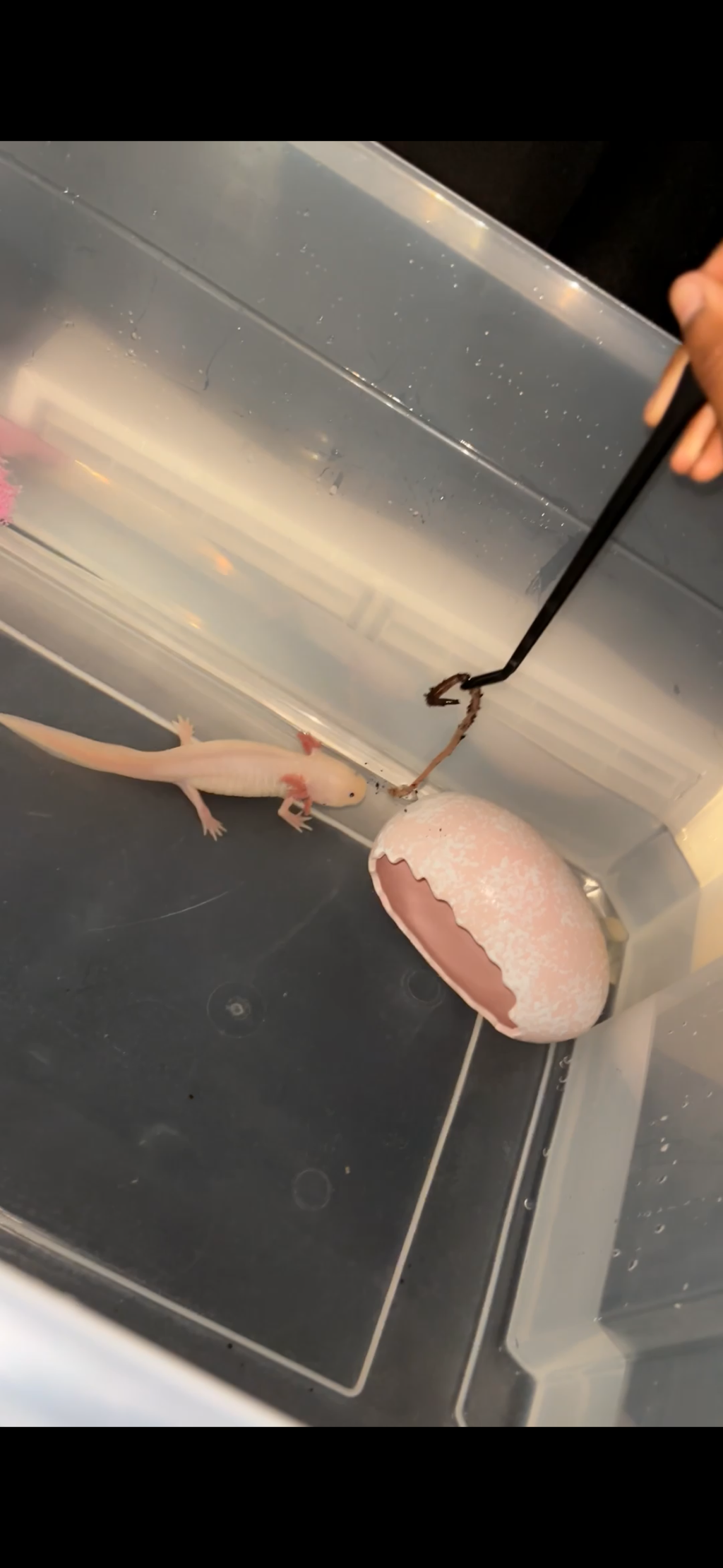
A new aquarium can look clean long before its filter is ready for an axolotl. Fishless cycling develops the biological filtration that processes waste, using a measured ammonia source instead of exposing an animal to that waste.
1. Understand what you are building
Waste produces ammonia. Ammonia-oxidizing organisms turn it into nitrite; nitrite-oxidizing organisms turn nitrite into nitrate. Ammonia and nitrite must both read zero before an axolotl moves in. Nitrate still needs to be controlled through water changes.
The filter media and other wetted surfaces provide a home for these organisms. Simply filling a tank, running the filter, or adding old aquarium water does not demonstrate that it can process waste. Your test results are the evidence.
2. Gather the products and equipment
The Fishless Cycling Kit combines one 125 mL bottle each of QuikCycl, Erase-Cl and MicroBacter Start XLF. It does not include the aquarium, filter, air supply or water tests. The Axolotl Start Bundle is a different water-care bundle and does not contain QuikCycl.
| What you need | Its role |
|---|---|
| Brightwell Erase-Cl | Conditions replacement water for chlorine and chloramines before bacteria are added. |
| Brightwell MicroBacter QuikCycl | Provides the measured ammonia-based nutrients for an empty-tank cycle. It is not the bacterial culture. |
| Brightwell MicroBacter Start XLF | The live freshwater nitrifying culture. Choose XLF, not the marine XLM version. |
| API Freshwater Master Test Kit | Tests ammonia, nitrite, nitrate, and pH. Check the kit's expiry and follow each reagent's mixing and timing instructions. |
| Running filter, air supply, thermometer, and suitable biological media | Keep media wet and water oxygenated. A sponge filter or an appropriately configured canister filter can provide biological filtration without excessive current. |
MicroBacter Lattice Medium is one filter-media option. Select the size and quantity for your filter and follow its product instructions; biological media goes in the filtration system, not loose on the tank floor.
You will also need a clean aquarium-only bucket, siphon, and graduated syringe or measuring tool. Keep these separate from household cleaning supplies.
3. Set up and condition the water
- Install the filter and media, fill the aquarium, and establish continuous circulation and aeration.
- Estimate the actual water volume, allowing for the fill level and displacement by equipment and décor. Product dosing is based on water volume, not merely the size printed on the aquarium.
- Treat chlorinated water with Erase-Cl according to its current label. Let the water circulate before adding the culture.
- Test and record the starting ammonia, nitrite, nitrate, pH, and temperature. Source water can already contain nitrate, so a later nitrate reading alone is not proof of cycling.
If using RO/DI water, prepare its mineral balance and buffering before starting. Plain RO/DI water is not a ready-made axolotl habitat. Florin Delta GH+, Florin Delta KH+, and Remineraliz have different jobs. GH+ and Remineraliz overlap in their effect on general hardness, so test and account for both rather than adding full doses automatically. TDS does not replace GH, KH, and pH tests.
4. Prepare the filter for the Brightwell method
Keep the biological filter and air running. Follow Brightwell's directions for disabling UV and removing fine polishing media during dosing. Do not confuse removable filter floss with the biological sponge or media you are trying to colonize.
Brightwell's QuikCycl protocol also calls for leaving activated carbon, GFO, and other phosphate removers out until cycling is complete and a further 30 days have passed. Read both current bottle labels before beginning; do not combine pieces of several manufacturers' cycling schedules.
5. Add the ammonia source and starter bacteria
Brightwell's published starting rate for QuikCycl is 1 mL per 5 US gallons. Its initial total-ammonia expectation is about 1–2 ppm. Measure carefully, let the water mix, and record the result. Do not keep adding more to force a particular color on the test chart.
Shake Start XLF thoroughly immediately before use. Its published new-aquarium seeding rate is 30 mL per 25 US gallons. Use it with QuikCycl for this fishless method; do not follow any separate fish-in instruction to add a hardy fish.
| Actual water volume | Initial QuikCycl | Initial Start XLF |
|---|---|---|
| 10 US gallons | 2 mL | 12 mL |
| 20 US gallons | 4 mL | 24 mL |
| 30 US gallons | 6 mL | 36 mL |
| 40 US gallons | 8 mL | 48 mL |
These are calculations from the published starting rates, not daily doses. If your bottle's current directions differ, use that label and confirm the change with Brightwell before proceeding.
6. Test every day and keep a log
At roughly the same time each day, measure ammonia, nitrite, pH, and temperature. Track nitrate as the cycle progresses. Note every product addition and water change so that falling readings can be interpreted correctly.
| Date and time | Ammonia | Nitrite | Nitrate | pH / temperature | Additions or changes |
|---|---|---|---|---|---|
| Day 1 baseline | |||||
| Day 1 after dosing | |||||
| Next daily check |
Ammonia may fall before nitrite does. That means part of the filter is working; it does not mean the tank is ready. You might not capture every rise on a daily test, especially with an effective starter culture. Clear water, cloudiness, and smell are not completion tests.
Follow the QuikCycl monitoring schedule rather than automatically topping up ammonia every day. Brightwell permits additional starter bacteria at specified points; check the current directions before doing so. Do not add a second kind of bacteria while Start XLF is establishing the cycle.
7. Confirm the tank can process waste
First complete the Brightwell protocol: ammonia and nitrite must both be zero, with evidence of nitrate production compared with the starting water. Day seven is a checkpoint, not a promised move-in date.
For an additional readiness check, verify that the empty tank can process a measured ammonia input with ammonia and nitrite both returning to zero within 24 hours. This is a general biofilter-capacity check, not Brightwell's printed day-by-day schedule. Perform it only after the initial protocol has reached zero ammonia and zero nitrite. Use the QuikCycl label's measured dose for the actual water volume; never copy another brand's drop count or exceed the label. Record the input and the 24-hour results.
If either reading is still above zero, keep the tank animal-free and continue monitoring. Do not repeatedly add challenge doses while nitrite or ammonia remains elevated. Ask us or Brightwell to review the log if you are unsure how to proceed. If the aquarium has been cycled at a different temperature, confirm performance again at its intended axolotl temperature before introduction.
8. Make the final water change and move-in checks
Once the cycle is established, change enough water to bring nitrate into the intended operating range. A fixed percentage is not a guarantee: for example, replacing half of water containing 80 ppm nitrate with nitrate-free water leaves about 40 ppm. Test the replacement water and calculate further changes if needed.
Condition replacement water, match temperature and water chemistry, and keep the biological media wet. Do not replace all the filter media as part of a final cleanup.
| Before an axolotl moves in | Check |
|---|---|
| Ammonia | 0 ppm |
| Nitrite | 0 ppm |
| Nitrate | Aim below 20 ppm; test again after the final water change. |
| Temperature | A stable cool-water target around 16–18°C / 61–64°F, with cooling arranged before the animal arrives. |
| pH | Stable, approximately 7.0–8.0; avoid rapid chemical adjustments to chase an exact decimal. |
| Equipment | Filter and aeration running, gentle flow, secure lid, and appropriate hides. |
Do not add more cycling ammonia after introducing the axolotl. Begin with the intended initial animal load, remove waste promptly, and check ammonia and nitrite daily during the first week. Continue frequent checks until the system's performance is consistent.
9. Maintain the cycle
Water changes control accumulating waste; bottled bacteria do not replace them. Test before your scheduled change, and adjust the frequency and amount to your readings, aquarium size, and animal load. Rinse dirty reusable media gently in removed aquarium water or conditioned water. Never wash the entire biological filter under untreated tap water or replace every biological surface at once.
FlorinBacter is a maintenance product, not the ammonia source in this guide. Brightwell's Start XLF directions name FlorinBacter Clean or FlorinBacter7 for maintenance after the cycle is complete and one additional week has elapsed. Check the label for the specific culture you choose. Follow its own label; it is not a reason to stop water testing.
Troubleshooting
- Ammonia falls but nitrite stays high: the second stage is catching up. Keep aeration running and avoid piling on more ammonia.
- Readings stop changing: verify test technique, filter operation, water treatment, temperature, and pH. Check KH if pH is falling. Review the log before adding another chemical.
- An accidental overdose or an off-chart test: stop dosing, keep animals out, and use a conditioned water change to bring levels back into a measurable range. Ask for product-specific advice before restarting additions.
- Nitrate appears immediately: compare with the source-water baseline. Nitrate alone does not prove that added ammonia and nitrite are being processed.
- The tank looks cloudy: test the water. Appearance does not tell you the biofilter's capacity.
- Your axolotl arrives before the tank is ready: do not put it into the cycling aquarium. Contact us before arrival so suitable temporary housing and daily water-care arrangements can be made.
Common questions
How long will cycling take?
There is no reliable calendar-only answer. Starter bacteria may shorten the process, but water chemistry, temperature, storage conditions, and filtration affect the result. Wait for verified performance, even if it takes several weeks.
Can I use plants while following this method?
Brightwell directs that plants stay out during QuikCycl fishless cycling. Add suitable plants after completion and recheck water quality. Do not substitute a different planted-tank protocol halfway through.
Can I use my water-care starter bundle alone?
Check its contents. Conditioner plus starter and maintenance bacteria does not include an ammonia source. This guide specifically requires QuikCycl and Start XLF, together with water conditioning and testing.
Can I leave a finished tank empty for a long time?
Keep the filter wet, running, and oxygenated, but do not assume old completion results remain valid indefinitely. Before adding an axolotl after a delay, review the feeding and testing plan and confirm the biofilter still processes a measured input. Never dose ammonia if an animal is already present.
For related setup information, read our Axolotl Tank Setup Guide, browse Brightwell bacteria and cycling products, or contact Axolotl Superstore with your test log.
Sources and product directions
Reviewed October 15, 2026. This is a freshwater fishless-cycling guide, not a claim of manufacturer certification for axolotls. Current bottle directions take priority for dosing.
- Brightwell: MicroBacter QuikCycl directions
- Brightwell: MicroBacter Start XLF directions
- DrTim's Aquatics: biological filtration and the 24-hour processing check — cited for the general capacity check, not its product doses.
- Brisbane Bird and Exotics Veterinary Service: Water Quality and the Nitrogen Cycle
- Tree of Life Exotic Pet Medical Center: Axolotl Care
Preparing purified water? Read our RO water and mineral preparation guide. After cycling, use our plant selection guide to plan suitable planting.