Axolotls come in an extraordinary range of colors, patterns, and finishes—but not every popular name describes a separate genetic morph. Some appearances come from well-documented pigment mutations. Others are combinations of several traits, fluorescent genes, or rare developmental events.
This guide explains the major axolotl morphs, quick identification clues, and the difference between established genetic traits and descriptive hobby names.
Looking for “morphed axolotl” instead of color morphs? Read what it means when an axolotl undergoes metamorphosis.
How Axolotl Color Works
Axolotl coloration is created mainly by three types of pigment cells:
- Melanophores contribute black and brown coloration.
- Xanthophores contribute yellow, gold, orange, and related warm tones.
- Iridophores reflect light and produce metallic, silver, or golden shine.
Different mutations affect whether these cells develop, migrate normally, produce pigment, or remain visible. More than one trait can occur in the same animal, which is why combination morphs can look very different from either trait by itself.
Quick Axolotl Morph Identification Guide
| Morph or Trait | Typical Appearance | Fastest Identification Clue |
|---|---|---|
| Wild Type | Olive, brown, charcoal, or mottled natural coloration | Reflective flecks and often a shiny eye ring |
| Leucistic | White to pale pink body | Pale body with dark eyes |
| Melanoid | Gray, charcoal, brown-black, or black | Matte finish with little or no reflective shine |
| Golden Albino | Cream, yellow, gold, or orange-gold | Golden body with pale or reddish eyes |
| Pink/White Albino | White, cream, or pink | Pale body with pink, red, or translucent eyes |
| Copper | Tan, cinnamon, peach-brown, or copper | Warm brown spotting instead of black spotting |
| Axanthic | Gray, silver-gray, charcoal, or violet-gray | Reduced yellow/gold coloration |
| GFP | Any base morph under normal light | Green fluorescence under suitable blue or UV light |
| Mosaic/Split | Irregular patches or sharply divided coloration | Distinctly different color regions on one animal |
Wild Type Axolotl
Wild type is the dark coloration most similar to the species' natural appearance. Captive wild types may be olive green, brown, gray-brown, nearly black, or mottled with metallic-looking speckles.
The easiest way to separate a dark wild type from a black melanoid is to look for reflective flecks and a shiny eye ring. Wild types often show them; melanoids generally do not.
Leucistic Axolotl
The leucistic axolotl—often called a Lucy or classic pink—has a white to pale pink body with dark eyes. Leucism is different from albinism because a leucistic axolotl retains dark pigment in the eyes.
Dirty Leucistic Axolotl
A dirty leucistic is a leucistic with dark freckles or patches, often concentrated around the face, gills, back, or tail. Pattern intensity varies greatly and may become more noticeable as an animal matures.
Black Melanoid Axolotl
Melanoid axolotls are known for charcoal, gray-black, brown-black, or deep black coloration. The defining clue is their matte appearance and lack of the reflective eye ring commonly seen in wild types.
Explore black melanoid axolotls
Golden Albino Axolotl
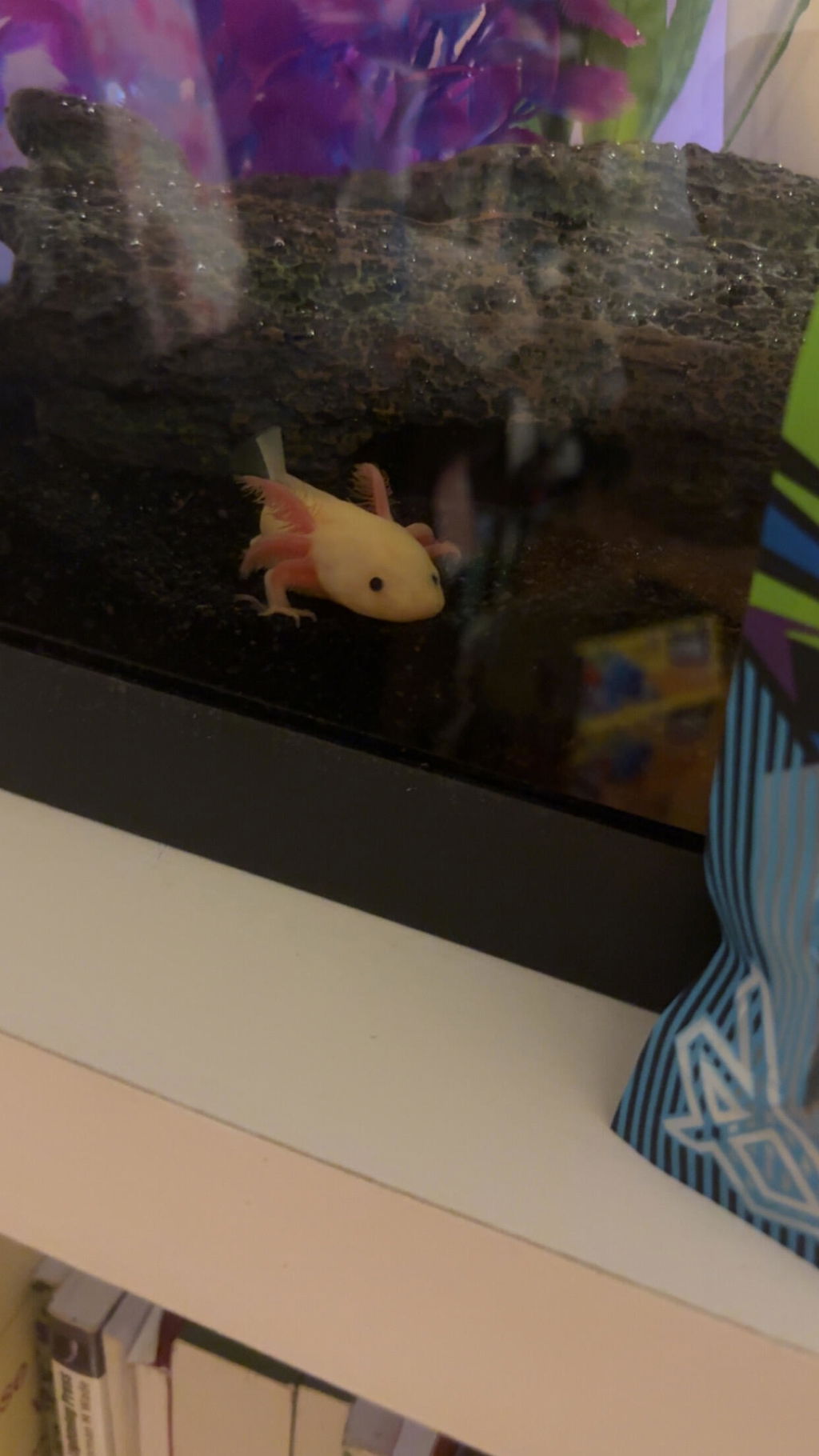
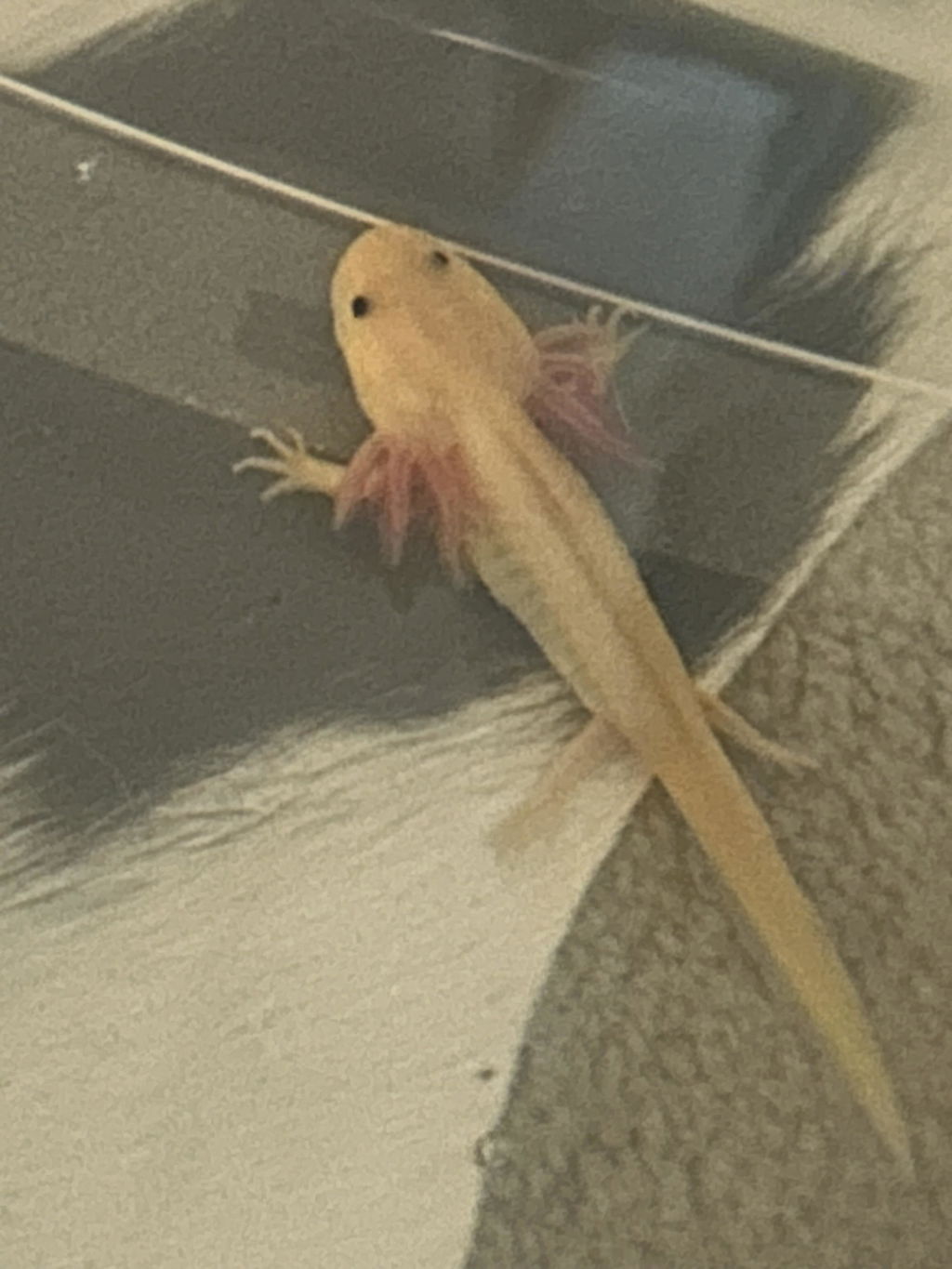
Golden albinos lack dark melanin but retain yellow pigment. Their bodies range from pale cream to bright yellow or gold, and their eyes are pale, pink, red, or translucent rather than black.
Pink and White Albino Axolotls
Not every albino is golden. Some combinations produce nearly white, cream, or pink animals. The quickest way to distinguish a pale albino from a leucistic is to check the eyes: leucistics have dark eyes, while albinos have pale, pink, red, or translucent eyes.
Copper Axolotl
Copper axolotls display warm tan, cinnamon, peach, rust, or reddish-brown coloration. Their darker pigment appears brown or copper rather than black.
Axanthic and Axanthic Copper Axolotls
Axanthic axolotls have reduced yellow coloration and typically appear gray, silver-gray, charcoal, or violet-gray. When axanthic and copper traits occur together, the result can be a muted taupe, gray-brown, or silver-copper appearance.
Lavender Axolotl
Lavender is a descriptive hobby name often used for animals with soft gray-purple or pastel coloration. Because the term is not one universally standardized genotype, lineage information is especially useful when evaluating lavender animals for breeding.
MAC: Melanoid Axanthic Copper
MAC stands for melanoid axanthic copper. This combination removes reflective shine, reduces yellow coloration, and shifts dark pigment toward brown. MACs commonly appear cocoa, earthy rust, gray-brown, or muted chocolate.
GFP Axolotl: A Trait, Not a Base Morph
GFP stands for green fluorescent protein. It is an inherited fluorescent trait that can occur with many base morphs, including leucistic, wild type, melanoid, golden albino, and copper.
GFP axolotls are fluorescent, not bioluminescent. They do not produce their own light and will not glow in complete darkness. Fluorescence is visible only while suitable blue or UV light illuminates the animal.
Mosaic, Split Mosaic, and Chimera Axolotls
Mosaic is used in the hobby for axolotls with two or more distinctly different color regions. Some show scattered patches, while others display a dramatic left-right division often called a split mosaic.
In genetics, the terms mosaic and chimera describe different developmental mechanisms, but pet-trade terminology is not always used consistently. Appearance alone does not necessarily prove exactly how an animal developed.
These patterns are unusual developmental events rather than ordinary single-gene morphs that can be reproduced predictably.
Blue, Purple, Dalmatian, and Enigma Names
Some popular axolotl names are descriptive trade terms rather than uniformly defined genetic morphs. Lighting, camera white balance, age, and combinations of known traits can make an animal appear blue or purple. “Dalmatian” is often used for heavily spotted pale animals, while “Enigma” has been used for unusual patterned animals without one standardized genetic definition.
When a name is not tied to a well-documented genotype, ask what known genetics and lineage are behind the label.
Can an Axolotl Change Color?
An axolotl cannot change from one genetic morph into another, but its visible shade and contrast can shift with age, lighting, substrate, blood flow, diet, and health. A dark axolotl may temporarily appear lighter on pale substrate, and freckles can become more noticeable as some leucistics mature.
Does Morph Affect Axolotl Care?
The basic care requirements are the same for every morph: a fully cycled aquarium, zero ammonia and nitrite, gentle filtration, suitable hides, appropriate food, and cool, stable water. The Ambystoma Genetic Stock Center maintains axolotls at about 60–65°F (15–18°C) and advises against temperatures above about 72°F (22°C).
A rare or expensive morph is not automatically healthier, friendlier, or harder to care for than a common morph.
Frequently Asked Questions
What is the rarest axolotl morph?
Rarity changes as breeding lines become more or less available. Naturally occurring mosaic and sharply split patterns are among the least predictable appearances because they result from unusual developmental events rather than straightforward planned inheritance.
Is a pink axolotl always leucistic?
No. Pale pink animals may be leucistic or one of several albino combinations. Check the eyes first: dark eyes strongly suggest leucistic, while pale or reddish eyes indicate albinism.
How can I tell a wild type from a melanoid?
Look for reflective flecks and a shiny eye ring. Wild types commonly show them; melanoids generally have a more uniform matte appearance.
Do GFP axolotls glow in the dark?
No. They fluoresce while illuminated by suitable light but do not make their own light.
Can mosaic axolotls reliably produce mosaic babies?
Mosaic and split patterns are not considered predictably inherited in the same way as ordinary recessive color traits. Breeding a mosaic does not guarantee mosaic offspring.
Are rare morphs harder to care for?
Not necessarily. Price and rarity are usually influenced by availability, breeding difficulty, pattern, lineage, and demand rather than different basic husbandry requirements.
Find Your Axolotl
Every axolotl is an individual. Even siblings with the same morph can differ in shade, spotting, gill color, body shape, and personality.
Ready to compare current animals? Browse available axolotls, see our 2026 axolotl price guide, or read what to look for when buying an axolotl online.